
Community Postcards: Let Your Neighbors Pay for Your Local Marketing
Ten local businesses split one printed card, it lands in 3,000+ mailboxes on your own streets, and the other nine slots cover the print run. I ran these for a while. Here are the real numbers, and the reason I stopped.

On this page
What are community postcards?
A community postcard is one printed card that features several local businesses and gets mailed to every home and business on a neighborhood route.
Each business rents a single spot for a flat fee, and the fees cover the printing and the postage with something left over.
One card, every mailbox on the route. Your listing rides along with the other businesses printed on it.
That last part is the whole idea, and almost nobody says it out loud. If you're the one who organizes the card, the other businesses on it are paying for your mailing.
The card sits on a counter or a fridge, so people see your name before anyone starts looking. A new mover checking restaurants. A homeowner who finally needs that repair.
Getting seen nearby is the hard part. A shared card fixes the reach and the price at once.
How did this work in practice?
I sold 10 to 12 slots on a card at $250 each. So a full card took in $2,500 to $3,000.
Printing and postage for the route ran roughly 40 to 50% of that, which is $1,000 to $1,500 depending on the size of the run.
Whatever was left over was mine.
Each card went to 3,000+ homes and businesses. A bigger route can carry 5,000 or more, which is where I'd aim if I ran it again.
| The line | What it was |
|---|---|
| Businesses per card | 10 to 12, none of them competing with each other |
| Price per slot | $250, paid once, for that mailing |
| Money in, per card | $2,500 to $3,000 |
| Print and postage | Roughly 40 to 50% of what came in |
| Households reached | 3,000+ per card, and a bigger route holds 5,000+ |
Work the per-door number and you can see why it holds up. A $250 slot across 3,000 homes is about eight cents a household, and a solo mailing to those same 3,000 doors costs you the whole print run.
Nobody selling this idea publishes that breakdown. I went looking, and the sites teaching the play talk up the operator's margin and won't tell you what the printer charges.
One new customer usually covers the whole slot.
So why did I stop?
The math worked every single time a card went out. Print and postage came out of what the slots brought in, and a full card always cleared it.
What didn't work was filling the card.
I texted businesses and I called them and I got almost nothing back. Cold email did worse.
Read this part twice if you're thinking about trying it. Selling ten slots is a door-to-door job wearing a marketing costume. If you aren't willing to walk the street, the economics never get a chance to matter.
The channel that would've worked is the one I couldn't run, which is walking the route and asking owners in person, shop by shop, over several days. I work from home, so that was never going to happen.
I'm telling you that part because leaving it out would make the whole thing sound easier than it was.
The recruiting is the job.
The math was never the problem. Ten conversations were.
How would you run this yourself?
If you own a shop on a walkable street, you're in a better position to do this than I ever was.

Price the route before you price a slot
Get a printer quote and a postage number for the exact route first. Once you know the run costs, say, $1,200, you know what ten slots have to bring in before you've made a dime.
Pick businesses that don't compete
One restaurant, one salon, one shop per category. Two pizza places on the same card helps neither one, and the second one will notice.
Walk in and ask, in person
This is the whole job, and the reason mine ended. Block out days rather than hours, and bring a printed sample so the owner can see what you're describing.
Collect the money before you send anything to print, because a card that's only eight tenths sold is a card you're personally funding.
Then mail it, and tell every business on it to expect a slow burn.
The calls don't come the week it lands. People keep the card and use it when they need you, which is the whole point of a thing that sits on a fridge, and it's also why owners decide mail failed before it has finished working.
Who community postcards actually work for.
If your best customers live and work near your business, a local mailer puts you in front of them directly. These are the ones that get the most out of a spot on the card.
A business that sells nationally online gets very little out of a route, because you're paying to reach a geography rather than an interest.
Where the postcard fits in your marketing.

A household gets the card, sees your name, and looks you up on Google before they call.
That moment is where your website and your local search presence carry the weight, and it's the half of this most people never plan for.
My guide on the free ways to get your name out locally lays out the moves that pair well with a mailer, and if you're weighing the bigger plan, my overview of local marketing strategies and what they cost is a plain place to start.
When someone looks you up after the card lands, strong local SEO for your business is what puts you at the top of that search.
The card gets the name in the house. The website closes the loop.
Event venues see this fastest, since a party planner who spots your card will research the space before they book. If that's you, my take on event venue marketing that fills calendars gets specific.
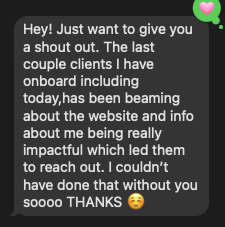
A couple of messages from clients about the website side of this.

Questions local owners ask about community postcards.
What are community postcards?
Community postcards are one printed card featuring several local businesses, mailed to every home and business on a neighborhood route. Instead of paying to design, print, and mail a whole card alone, each business rents a single spot and the group splits the cost of the mailing. It's the cheapest way I know to get a local name into 3,000 mailboxes at once.
How much does a community postcard mailing cost to run?
A community postcard mailing costs whatever your printer and the post office charge for the route, and on the cards I ran that came to roughly 40 to 50% of what the slots brought in. I sold 10 to 12 slots at $250 each, so a full card took in $2,500 to $3,000 and print plus postage ate $1,000 to $1,500 of it.
How many households does one community postcard reach?
One community postcard reached 3,000+ homes and businesses on the routes I mailed, and a bigger route can carry 5,000 or more. Every address on the route gets the same card, so there's no list to buy and no targeting to guess at. The trade is that you reach everybody, including the people who will never buy from you.
How many businesses should go on one card?
Ten to twelve businesses on one card is the number that worked for me. Fewer than ten and the print run stops paying for itself, and more than twelve and each listing gets too small to read from arm's length. Keep them non-competing, because two pizza places on the same card helps neither one.
How do you find the other businesses for a shared postcard?
Finding the other businesses is the hard part of a shared postcard, and it's the reason mine stopped. Texting and calling produced almost nothing, and cold email produced less. The channel that actually works is walking into the shops on the route and asking in person, and that takes days rather than an afternoon.
Does direct mail still work for a local business?
Direct mail still works for a local business because a physical card lands in a hand and then sits somewhere. A card on a fridge is visible every day for a month, which is a kind of attention no feed gives you. It's a first-touch channel, so judge it by whether people start showing up and searching your name.
Can community postcards work alongside my online marketing?
Community postcards and online marketing pull harder together than either one does alone. A postcard gets your name in front of a household, then that household searches you on Google, which is where your website and local SEO take over. The mailer earns the most when the rest of your marketing is ready to catch the traffic.
What kinds of businesses should use community postcards?
Community postcards fit any local business that serves the people who live and work nearby. Restaurants, salons, auto shops, home services, medical and urgent care, event venues, and neighborhood retail all do well, because their customers come from the surrounding streets. A business that sells nationally online gets very little out of a route.
Can one new customer pay back the cost of a postcard slot?
Do the math against your own ticket size: if a customer is worth $250 or more to you, one new one covers the slot, which is the whole reason the shared card is worth trying. A single client or a handful of orders usually clears it, depending on what you sell. That's a low enough bar that the real question is whether you can fill the card, not whether the card pays.
Is community postcard marketing worth doing in Spanish?
Community postcard marketing works in Spanish, and on a Spanish-speaking route it works better. I work with Spanish-speaking business owners across Baltimore and the DMV, and a card that reads in the language of the street it lands on gets read instead of recycled. The route reaches the same households either way.
Why did you stop running community postcards?
I stopped running community postcards because I couldn't fill the cards. The economics were fine and the math worked every time one went out. Filling the card is what didn't work: texting and calling businesses got me almost no replies, cold email got fewer, and the thing that would've worked is knocking on doors up and down the route. I work from home, so that was never going to happen.
If you'd rather map out how print fits the rest of your plan before you print anything, get in touch with a marketing consultant. I'm a Baltimore marketing agency of one, so the person who ran these cards is the person you'd be talking to.
Want in on the next print run?
Send me the business and I'll tell you what's still open.
- 450K+ search impressions across the sites we manage
- 5,800+ organic search clicks across the sites we manage
- 600+ leads and booking requests across the sites we manage
Last 90 days, across the sites and Search Console/GA4 accounts Another Monday manages. Figures as of August 2026.
Let's get you seen on your own street.
Book a free strategy session and I'll map the local marketing that fits your business, print and online, so you see the plan before you spend a dollar.
¡También Hablamos Español!